Where the boundary lives, per platform¶
foldyard stacks up to three isolation layers, and which layer carries the weight differs by host. This page says which, per platform, so a uniform-looking config doesn't hide a real difference. Terms used here are defined in the glossary.
The one sentence that explains the rest: on macOS the VM is a necessity; on Linux it is a choice. Containers need a Linux kernel, so a macOS host must run a VM to have containers at all — the isolation comes with it. A Linux host already has the kernel, so its VM exists only to be a boundary, and has to justify its cost on that alone (ADR-0027 settled that it does: foldyard always runs one).
The dated measurements behind this page — the rig sessions, the benchmark tables, the probes — are in archive/isolation-layers-sessions.md.
The three layers¶
  ┌─────────────────────────────────────────────────────────────────┐
  │ HOST            credentials · supervisor · token services       │
  │                 allow-store · the egress proxy · your editor    │
  └───────────────────────────┬─────────────────────────────────────┘
                              │  ① machine layer  (the VM)
                              │     mounts: repo + worktrees root ONLY
                              │     the VM firewall (in-VM nftables)
  ┌───────────────────────────┴─────────────────────────────────────┐
  │ VM              rootless podman  ·  libpod socket ──▶ the host  │
  └───────────────────────────┬─────────────────────────────────────┘
                              │  ② container layer  (the engine)
  ┌───────────────────────────┴─────────────────────────────────────┐
  │ dev box + the compose stack     ③ optional: gVisor under the box│
  │ agents run here                    ([machine] runtime = "gvisor")│
  └─────────────────────────────────────────────────────────────────┘
Legend¶
Older docs, ADRs and code comments use the numbered and lettered shorthand; this page uses the names.
| shorthand | name here | what it is | config |
|---|---|---|---|
| ① | machine layer | the per-project VM: its own kernel, mounts only the repo and worktrees root | [machine] backend, vmtype |
| ② | container layer | ordinary rootless containers on the VM's kernel: the box and the stack | — |
| ③ | sandbox layer | gVisor's userspace kernel under the box, so a container→kernel exploit must beat gVisor's Sentry before it reaches the VM kernel | [machine] runtime = "gvisor" (ADR-0025) |
| (a) | Lima/QEMU VM | Linux's shape: the machine layer on QEMU/KVM, containers share its kernel | backend = "lima" (vmType qemu) |
| (b) | microVM per container | no VM, each container in its own libkrun microVM — retired with the native backend (ADR-0027) |
— |
| (c) | stacked microVM | (a) with the box in a libkrun microVM inside it — measured and deferred on cost | — |
Before ADR-0025 (2026-09-13), ③ meant a libkrun microVM (--runtime krun); it now means
gVisor. The libkrun route is the deferred stacked microVM (c).
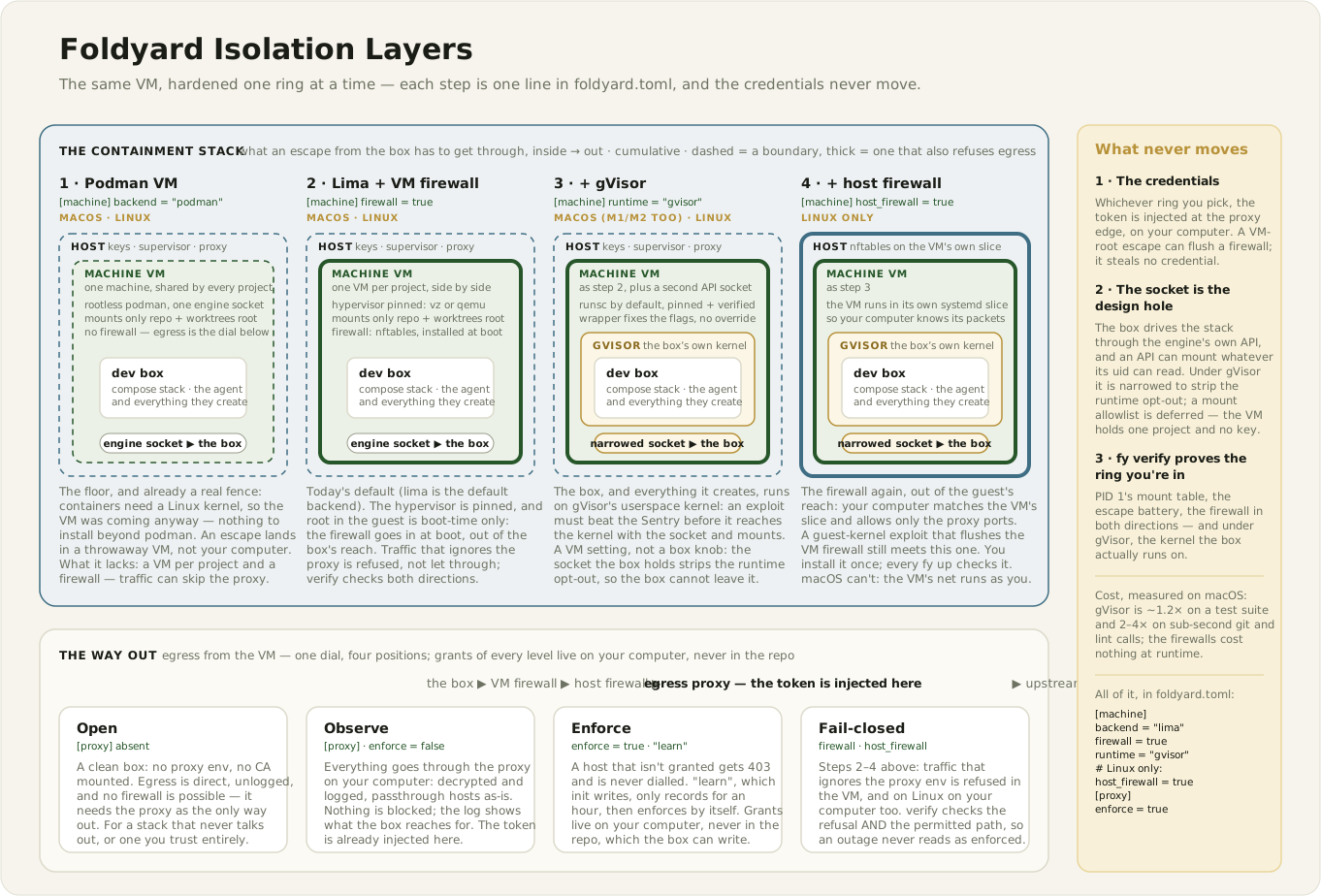
The same layers as a hardening ladder — one ring per step, each a line in foldyard.toml, with
the egress setting alongside:
macOS (arm64) — the machine layer does the work¶
    Apple EL2  (hardware virtualisation, in silicon + xnu)
        │                                   ← IDENTICAL on both paths
        ├── Hypervisor.framework ............ low-level: vCPU + memory only
        │      └── libkrun.dylib  (Rust; VMM + a small virtio set)
        │            └── krunkit            [com.apple.security.hypervisor]
        │                  ├── podman machine --provider libkrun
        │                  └── Lima  vmType: krunkit          ← opt-in
        │
        └── Virtualization.framework ........ Apple's own VMM + device model
               └── vfkit / Lima vz driver     [com.apple.security.virtualization]
                     └── Lima  vmType: vz                     ← the default
The hypervisor is the same either way. Choosing krunkit over vz swaps the userspace VMM and device model, not what enforces isolation in hardware. That bounds both the risk and the benefit: the device-model half shrinks, the hypervisor half is untouched.
A macOS host runs neither QEMU nor Linux KVM — the two components the agent in Trail of Bits' report
actually escaped (archive/firecracker-and-microvm-backends.md).
Moving macOS hosts to QEMU "for uniformity with Linux" would be backwards: Lima's QEMU driver on macOS
uses the same Apple hypervisor (hvf) and adds QEMU's device model on top — more attack
surface, and much slower. One honest caveat on vz: Apple's implementation is closed, so its low
public CVE count is partly an absence of research.
Neither path jails the VMM. libkrun's own README says the guest and the VMM share a security
context, and that isolating them is the host OS's job. Virtualization.framework also runs the VM
inside the calling process, so Lima's vz host agent is in the same position. A VMM escape
therefore lands in an unconfined process running as you, with your home directory, the login
keychain, ~/.foldyard and the whole network in reach. The VM firewall does not survive a VMM
escape — it confines the guest kernel, not the host process running it.
What is open on macOS:
- No VMM jailer, and no obvious way to add one. macOS has no namespaces; the only candidate,
sandbox-exec, is deprecated and neither Lima nor krunkit applies it. - No host firewall. Lima's user-mode network runs as you, and pf cannot single that process
out without a dedicated uid or a different network mode.
hostwall.available()reports the capability absent rather than branching on the OS. - No microVM for the box. A libkrun box needs
/dev/kvminside the VM, which Apple silicon offers only on M3+ with macOS 15+; M1/M2 must be supported, so the stacked microVM is Linux-only. The sandbox layer is gVisor instead, which needs no KVM and runs on M1/M2. On macOS the chain is host ← VMM ← guest kernel ← gVisor ← box. - krunkit stays opt-in. A smaller device model, but upstream-experimental, installed at a Homebrew path that moves with each upgrade, and never run under a sustained workload. foldyard never selects it automatically (configuration.md).
Linux — the machine layer is QEMU, and QEMU is the price¶
   (a) LIMA/QEMU VM — what ships          (b) MICROVM PER CONTAINER — retired
   backend = "lima", vmType: qemu         (was backend = "native" + --runtime krun)

   host ──① QEMU/KVM VM                   host ── (no VM)
            └─② containers                         └─② containers, each in a
               share the VM kernel                     libkrun microVM with
                                                       its own kernel
   ✅ repo-only mount                     ❌ engine sees the whole host filesystem
   ✅ VM firewall (in-VM nftables)        ❌ no VM to put the firewall in
   ✅ host firewall (on the QEMU process) ❌
   ✅ concurrent per-project VMs          ✅ per-container kernel isolation
   ❌ QEMU device model                   ✅ minimal device model
foldyard always has a VM (ADR-0027), so on Linux the shape is (a). The (b) column stays as the record of what it traded away.
Lima on Linux does not give you libkrun. Lima registers only qemu there; krunkit is a
macOS/arm64 binary. So Lima on Linux buys the boundary, the mount and the firewalls, with QEMU as
the knowingly accepted weak link — not uniformity with macOS.
The mount is 9p, and can't be pinned to virtiofs yet. Lima's QEMU driver defaults
mountType to 9p, which is slower on the build path and the more escape-prone of the two. But
under Lima 2.2.0's rootless virtiofsd 1.14, every file create on a virtiofs mount fails with
EINVAL (Fedora and Ubuntu guests alike), so 9p stays until upstream moves. Keep caches and the
venv off the mount ([box] shadow_volumes, caches — configuration.md);
the mount is the dominant cost under any runtime.
Lima + QEMU on Linux (foldyard's own lima backend)¶
What the lima backend does on a Linux host (first measured 2026-09-11; now run on every
lima-host-e2e and wsl2-host-e2e CI job — the CI section of DEVELOPMENT.md):
resolve_vmtype()picksqemufromlimactl info, not from the OS.- The host needs
qemu-img(packageqemu-utils/qemu-img), whichqemu-system-x86-coredoes not pull in. /dev/kvmis present inside the guest (Lima passes-cpu host, and nested KVM is on by default on x86), which is what makes a stacked microVM possible at all.- The mount is 9p (above).
- The VM firewall works unchanged: direct egress from the guest is refused, DNS to the local resolver still resolves. The boot script is driver-independent.
fy verifyis ALL PASS, and FAILs against a VM deliberately mounting the whole host home (tests/test_verify_e2e.py).
The engine socket is a hole by design¶
The (b) column lost the repo-only mount and the firewall not because there was no VM, but because the box holds the engine socket, and a libpod socket can bind-mount anything its uid can read and reach anything its host can reach. The VM never created those properties; it bounded what the socket could get at. So:
- Whatever the socket allows, an agent in the box can do with no exploit at all. A microVM or gVisor removes the exploit route (the shared kernel); narrowing the socket removes the by-design route (the API). Neither substitutes for the other.
- Built: under
[machine] runtime = "gvisor"the box holds a filtered socket that strips every runtime opt-out (oci_runtime,dev.gvisor.*, compatHostConfig.Runtime) from container creates and refuses what it can't parse, so a sibling can't escape gVisor (ADR-0025;src/foldyard/assets/sandbox/socket_filter.py). - Deferred: a broader mount/endpoint allowlist, so a box-created sibling can't bind-mount the
VM's
/. On one VM per project that sibling reads only this project's VM, which holds no credentials, so it is defence in depth (ADR-0025, Decision §5).
The verb isn't the boundary; the config it consumes is. A tempting narrowing is a broker that
lets the box run compose up but not run -v /:/host. It buys nothing while the compose file sits
in the checkout the box can write: up re-reads that file, so adding privileged: true, a
/:/host volume or a command: override to it is the raw socket again. A broker is only a
boundary if the topology it runs is frozen outside the box's reach, takes no pass-through
arguments, and changes only through a step a human approves — what the adopted config does for
foldyard.toml (ADR-0022). The deferred allowlist
above has to pass the same test.
Hardening that ships, beyond the VM¶
In order of cost (all zero at runtime):
- Root in the guest is boot-time only. The box runs as the VM user's uid, and Lima's
cloud-init gives that user passwordless sudo on every boot — one
sudo nft flush rulesetfrom open egress after a container-runtime escape. foldyard's boot script narrows the grant toshutdownand installs the VM firewall as root on every boot; the host never runssudoin the guest (lima-wall-machine-integration.md). After that, only a guest-kernel exploit reaches VM-root. - The host firewall (
[machine] host_firewall, below) closes that last gap on Linux. - The sandbox layer (
[machine] runtime = "gvisor", below) puts a second kernel between the box and the VM kernel.
What all three protect is bounded by the one property that holds everywhere: real credentials never enter the VM. Even a VM-root escape steals none; it can only reach what the VM holds.
Host firewall on Linux¶
[machine] host_firewall = true enforces the same egress rule on the host, where the guest has
no reach, so flushing the VM firewall gains nothing. Design reference:
lima-wall-machine-integration.md §3;
code: src/foldyard/hostwall.py. In short:
- It matches the VM process by cgroup, not uid. Lima's QEMU driver runs the guest's user-mode
network inside
qemu-system, so every guest packet leaves the host as that process. foldyard starts the VM in a per-VM scope under a persistent per-VM slice, and nftables matches the slice (socket cgroupv2); your other processes share your uid but not the slice. - The table is the same every boot. Loopback flows the VM opens carry a per-project conntrack mark and are judged on the INPUT hook by the listening socket's cgroup: the VM's own plumbing (Lima's host resolver, the SSH forward, on ports Lima picks per boot) or this project's port range, nothing else. No port is read from a running VM.
- You install it once; foldyard probes it on every
fy up(ADR-0028).fy machine host-firewallrenders the table and a system unit and prints thesudolines; foldyard never elevates. Eachfy upthen runs a probe inside the slice and refuses to start if the firewall isn't enforcing. A probe, not a read, because the table can't be read without root and a loaded table can hold a dead slice's id and match nothing. - Fail-closed. Preflight refuses
host_firewallwithoutfirewall, or on a host withoutnftand cgroup v2;ensurerefuses a VM running outside its own scope-under-slice. - Not on WSL2: the stock WSL2 kernel has no
CONFIG_NFT_SOCKET, so the rule can't load and the option fails closed. The VM firewall is unaffected.
The stacked microVM (c): measured, deferred¶
Nested KVM is on by default on x86, so a libkrun box inside the Lima/QEMU VM works:
   host ──① Lima/QEMU VM  (repo-only mount, the firewalls, concurrency)
            └─② crun container  (namespaces · cgroups · seccomp = the VMM's jailer)
               └─ libkrun microVM  ← the box, on its own kernel
It has the one thing no other shape here has: the VMM is jailed, because crun builds the
container first and boots libkrun inside it. But it was deferred on cost (2026-09-11): process
creation costs ~8 ms under nested libkrun against ~0.5 ms under crun, and every virtio-fs
metadata syscall is a 50–80 µs round trip, so git status runs 27× slower and a package install
7×. That is the box's whole workload. None of the tuning options moved it (split irqchip, newer
libkrun, more vCPUs); x2APIC in libkrunfw would help at most a quarter. Reassess when libkrun 2.0
is drivable by crun. The engine socket also doesn't cross virtio-fs into a microVM; a sidecar in
the same pod exposing it over pod-loopback TCP works. Numbers:
archive/isolation-layers-sessions.md.
The sandbox layer: gVisor¶
[machine] runtime = "gvisor" runs the box, and everything the box creates, under gVisor's
runsc (systrap platform, directfs on). It is a machine setting, not a per-box one, so the box
can't opt itself or a sibling out. How it's wired: machine ensure installs a pinned runsc
user-level in the guest and starts a second podman API service whose default runtime is runsc;
fy box up creates the box through it and hands the box the filtered view of that socket
(ADR-0025,
configuration.md). In-box fy verify checks the box's kernel is gVisor's.
It needs no KVM, so it works on M1/M2 Macs and Linux alike. Measured cost against crun, warm, with the venv in a volume as foldyard's box runs it:
| workload | macOS (M3, vz) | Linux rig (x86, nested QEMU) |
|---|---|---|
| this repo's test suite, serial | 1.2× | 1.6–2.0× |
git status / git grep |
2.2–2.4× | ~2× (1–1.2× on the warm 9p mount) |
ruff check |
2.4× | 2.4× |
fork/exec (/bin/true ×2000) |
4.2× | 11× |
uv sync --frozen, warm |
6 → 14 ms | 1.1 → 1.4 s |
The cost is gVisor's syscall path (CPU), not the mount: off the mount the suite's ratio is the same. The rig is one hypervisor level deeper than a laptop, so its ratios are upper bounds.
Things to know when you turn it on:
- Keep directfs on (the default): off, git walks go from ~3× to ~9×.
--ignore-cgroupscosts nothing here: the box sets no per-container limits; the VM's sizing is the ceiling.- inotify doesn't cross into the sandbox. A watcher in the box sees the box's own writes but
not edits from the host. File-watching dev servers need polling (
CHOKIDAR_USEPOLLING,nodemon -L,watchexec --poll). - The
kvmplatform is not a speed-up under nesting: on the rig it was 5× slower than systrap. On a bare-metal Linux host it may be faster; unmeasured.
WSL2 — a Linux host whose Hyper-V boundary protects the wrong asset¶
   Windows ──[Hyper-V]── WSL2 distro  (the host, for foldyard)
                          │  supervisor · token services · allow-store · credentials
                          └──① Lima/QEMU VM ──② containers
The distro is not the boundary. The supervisor runs inside it, so the credentials live in the distro, exactly as on bare Linux. Hyper-V separates Windows from the distro; it puts nothing between an agent and those credentials. A VM-less engine in the distro would be bare Linux without a VM, which is why that shape is gone (ADR-0027).
WSL2's options are the Linux options. The stock WSL2 kernel builds KVM as modules, and with
nested virtualisation on, /dev/kvm is in the distro; foldyard's lima backend boots its
QEMU VM there unchanged. Measured in CI on 2026-09-17 (the wsl2-host-e2e job, a hosted Windows
Server 2025 runner, nestedVirtualization=true in .wslconfig): the full host tier passes.
Details: the CI section of DEVELOPMENT.md,
linux-support.md.
Limits:
- No host firewall. The stock WSL2 kernel has no
CONFIG_NFT_SOCKET, so[machine] host_firewallcan't load and fails closed. The VM firewall runs in the guest and is unaffected. - Windows 10 silently overrides
nestedVirtualization; Windows on ARM boots the distro at EL1, so KVM can never work there. Windows 11 enables nested virtualisation by default on x86; a real Windows 11 client machine has not been checked (wsl --shutdown; wsl; ls -l /dev/kvm). - Keep the checkout on the distro's own filesystem.
/mnt/cis automounted in the distro, but the VM mounts only what foldyard declares, so automount doesn't reach the boundary. A repo under/mnt/cwould be 9p over drvfs with 0777 modes and CRLF endings. - Lima's Windows-side
wsl2driver is experimental and not the route.
What fy verify proves, per platform¶
A boundary nothing checks is asserted on trust. fy verify derives the host's paths from the
real host (verify._host_paths), reads the VM's mount table from PID 1 (not a container's view),
and gates every absence check on a positive control — see
archive/verify-false-pass.md for how each of those was found.
| claim | checked by | macOS | Linux | WSL2 |
|---|---|---|---|---|
| a VM boundary exists; the escape probe is refused | fy verify |
✅ | ✅ | ✅ |
| repo-only mount | fy verify (PID 1's mount table) |
✅ | ✅ | ✅ |
VM firewall refuses direct egress (and :53 to the internet) |
fy verify in the box; the guest's boot report on every fy up |
✅ | ✅ | ✅ |
| host firewall enforcing | a probe on every fy up; fy doctor |
❌ not available | ✅ | ❌ kernel lacks it |
| box under gVisor | fy verify in the box (kernel release) |
✅ opt-in | ✅ opt-in | not tested |
| microVM device model | — | ⚠ krunkit only, opt-in | ❌ QEMU | ❌ QEMU |
| VMM jailed | — | ❌ runs as you | ❌ QEMU runs as you (the host firewall confines its network, not its files) | ❌ same as Linux |
Under gVisor the in-box mount audit reports N/A: the sibling it uses can't reach the VM kernel,
which is the point. fy verify on the host still runs it over the default socket.
Where each claim is tested¶
| where | covers | can't cover |
|---|---|---|
CI lima-host-e2e (x86 Ubuntu 24.04 runner, Lima/QEMU) |
the Linux host tier: machine ensure, both firewalls via fy up, box, worktrees, fy verify including the leaky-home FAIL |
arm64 (no KVM on the arm64 runners) |
CI wsl2-host-e2e (Windows Server 2025, WSL2, Lima/QEMU inside) |
the same tier on WSL2; the host firewall test skips | a Windows 11 client |
| a macOS host, by hand | the default vz path, krunkit, gVisor on arm64 | anything Linux-only |
| a nested x86 Linux VM (nested-virt.md) | the stacked microVM, gVisor's kvm platform, podman 6 guests |
bare-metal numbers (one level deeper than a laptop) |
| any x86 Windows 11 machine | /dev/kvm in the distro — a two-minute read-only check |
— |
Still open¶
- krunkit as a supported option, not a probe: a sustained workload, and a decision on carrying an experimental driver at a moving Homebrew path.
- A VMM jailer on macOS: no candidate.
- The broader socket allowlist (mounts and endpoints), deferred in ADR-0025.
- virtiofs under Lima on Linux: fails every file create; 9p until upstream moves.
- The stacked microVM: reassess when crun can drive libkrun 2.0 and libkrunfw enables x2APIC.
- gVisor: the
kvmplatform on a bare-metal Linux host; WSL2. - Windows 11 client: the
/dev/kvmcheck.
Closed: per-session snapshots (not wanted); a krun box on M3 Macs (krun is Linux-only, and deferred there; the sandbox layer is gVisor).
Sources¶
- The measurements: archive/isolation-layers-sessions.md (macOS 2026-09-07; the GCP rig 2026-09-11 to 09-13).
- Why not Firecracker: archive/firecracker-and-microvm-backends.md.
- libkrun README (security model, 2.0 status): https://github.com/libkrun/libkrun · crun's krun handler: https://github.com/containers/crun/blob/main/krun.1.md, https://github.com/containers/crun/blob/main/src/libcrun/handlers/krun.c.
- WSL2 stock-kernel KVM: https://www.boxofcables.dev/accelerated-kvm-guests-on-wsl-2/ · the Windows 10 override: https://github.com/microsoft/WSL/issues/40735.